Friday, October 11, 2013

Life Skills Improved When Horses are Involved


Horses do so much to help us and are amazing animals.  I hope someday that I will be able to have a horse of my own to love and care for  :-)  ~Declan


Life skills improved when horses are involved


kid-stock

A scientific study has revealed that an involvement with horses boosts the life skills of young people. Horses, the study found, acted as both teachers and friends for young people.

The USn study, using a simple linear regression analysis, even managed to quantify the improvement in life skills.

The study indicated that about 25% of youths’ life skills development are attributable to their development of horsemanship skills.

The Impact of Equine Activities on Youth Development Study was conducted by the Pennsylvania State University Department of Dairy and Animal Science in co-operation with the American Youth Horse Council, 4-H, the American Quarter Horse Youth Association, United States Pony Clubs and the National High School Rodeo Association.

The American Youth Horse Council has long believed that involvement with horses had a positive impact on youth, but evidence to support the claim had been limited.

Youths who learnt horsemanship skills showed better decision-making, thinking, communicating, goal-setting and problem solving.

Working with horses helped them develop positive values and life skills that are transferred to a young person’s daily life.

The organisations who co-operated in the research represented more than 450,000 youths.

The findings will hardly come as a surprise to parents such as Samantha Armstrong. “The daughter who won’t lift a finger in the house is the same child who cycles madly off in the pouring rain to spend all morning mucking out a stable,” she says.

Aside from life skills, young people also benefit through the physical demands of riding and horse care.

“Horseback riding is a complex and demanding physical sport,” the report says.

“Riders develop coordination, balance, fine motor skills, muscular strength and endurance, flexibility, and can improve posture and cardiovascular health.

“Additionally, the daily care of horses further develops physical fitness and instills a source of regular physical activity in a child’s life.

“The partnership that youth form with their horses demonstrates the mental development that benefits youth for years to come.

“Horseback riding teaches teamwork in a very immediate way. Communication between the horse and rider is key to translating cues from the rider to the action of the horse.

“Development of this communication process requires the rider to be attentive to their mount and to process many visual, tactile and auditory inputs.”

pilly-baby-spice

Working with horses improved young people’s self-esteem and confidence, the study found.

“The emotional benefits of horse involvement are evident in the relationships that youth form with horses.  Caring for horses allows youth to form lasting bonds with animals and practice nurturing skills.

“Daily horse chores play a role in developing a sense of responsibility, empathy and compassion; important skills for starting and maintaining relationships with others.

“The horse also provides unconditional acceptance, as well as emotional support for their young caretaker.”

Horses serve as both teachers and friends, and in both roles, positively impact the physical, mental and emotional well-being of youth.

“Over the years I have seen miraculous cases of troubled youth, who are literally saved from traveling down the wrong path in life through horse involvement,” said Extension Horse Specialist Dr Ann Swinker. “The sense of pride that kids feel when they reach a goal with their four-legged friends, gives them every reason to remain on course.”

The study found that most of those who took part (86.9%) were female, and most (87.8%) owned their horses. Some, however, shared or leased an animal.

It found that once young people became involved in equine activities, they invested much of their time and energy to their new hobby.

Horse involvement also proved to be a chance for young people to foster relationships with adults and peers.

Results indicated youth horse programmes should continue to develop and support a focus on the development of horsemanship skills and life skills. Volunteer leaders should place increased emphasis on safety, health management and nutrition, as results indicated that these contribute significantly to life skills development.

More than 90% of youths in the study indicated that having fun with their horse was important. Over 80% indicated that riding their horse was important.

Interestingly, less that 50% indicated that winning a ribbon or winning a blue ribbon at horse events was important.

Thursday, October 10, 2013

Donkey Ambulance Could Be Major Life Saver


EQUINES ROCK!!!!! ~Declan


Donkey Ambulance could be major life-saver


Donkeys are to become life-savers in Afghanistan with a new innovation to help save the lives of women and their unborn children.


The innovative new Donkey Ambulance, developed by British non-governmental organisation HealthProm and designer Peter Muckle, aims to minimise delays to accessing healthcare facilities. It provides greater comfort and helps protect both the mother and unborn child on the journey from the villages to the health centre.

The Donkey Ambulance has been created to help save lives in countries such as Afghanistan.
The Donkey Ambulance has been created to help save lives in
countries such as Afghanistan.
Muckle took items such as inflatable camping cushions, the armrest from an air bed and part of an inflatable pool lounger, and stitched them together into a puffy chair that could be strapped to a donkey’s back.

HealthProm started its project to reduce maternal and newborn deaths in one remote, mountainous district in the north of Afghanistan in 2008.

The design is now at the testing and evaluation phase, after which it will be reproduced locally by Afghan artisans for use in the villages.

Maternal deaths are ten times higher than the number of civilians killed in conflict. Afghanistan has the highest maternal death rate in the world, at 1575 per 100,000 births.

One woman in every eight dies of pregnancy related causes and one in four children dies before his or her fifth birthday. The situation is even worse in remote areas. Research shows that the causes of newborn and maternal deaths can be attributed to a number of key factors, including absence of emergency transport to take women in labour to health centres.

In mountainous regions, bumpy tracks make motorised or wheeled transport extremely difficult.

Stewart Britten, project co-ordinator at HealthProm, said: “Afghanistan has probably the highest maternal mortality ratio in the world and a major factor in this is the delay in seeking a skilled birth attendant.

“If a low-cost solution works sustainably, with local production using largely locally available materials, we hope that the reduction in mortality figures will lead to its replication in other parts of Afghanistan and other very low-income countries with similar terrain.”

The Donkey Ambulance was showcased at the recent Conference on “Appropriate Healthcare Technologies for Developing Countries: Low-cost, frugal technology medical devices” organised by the Institute of Mechanical Engineering in London.

The World Health Organisation (WHO) estimates that as much as three quarters of all medical devices in the developing world do not function because the vast majority are built specifically for Western markets.

Expensive and difficult to replace parts, the need for a constant electricity supply, a lack of trained operators or their unsuitability to rough terrain are all factors preventing the use of these devices in the developing world.


donkey-saddle.afghanistan


Wednesday, October 9, 2013

At Age 3 - Youngster Qualifies for Prestigious Show Despite Only Just Learning to Ride


 GO HARRY!!!  ~Declan


Just champion! Harry, 3, rides his way into history: Youngster qualifies for prestigious show despite only learning to ride this year


  • Harry has already won an impressive four best rider titles at local shows
  • Awarded near-top marks for performance atop four-year-old pony Divine
  • Youngster is not intimidated despite the age of him and his horses

By DAILY MAIL REPORTER  As posted on Mail Online
One of Britain’s youngest horse riders will make his debut at a prestigious national event this week - aged just three.

Talented Harry Edwards-Brady will be watched by thousands of people when he takes to the stage at this year’s Horse of the Year Show (HOYS).

The tot only began riding earlier this year but is already well on his way to becoming an expert rider.

Celebrations: Harry Edwards-Brady qualifies for the Horse of the Year show

Harry, who has already won an impressive four best rider titles at local shows, has qualified two different ponies for the event.

He stunned crowds at a HOYS heat with a near-perfect score in July this year.

    Judges at the Royal Norfolk Show awarded him 48 out of 50 marks for his performance atop four-year-old Dartmoor pony Divine.

    Harry’s other pony, Gryngallt Page Too, is also aged just four and only launched his showing career at the start of this season.

    On form: Harry racked up a near-perfect score on Dartmoor pony divine
    On form: Harry racked up a near-perfect score on Dartmoor pony divine

    And the toddler is hoping to become one of the youngest ever winners when he makes his national debut at Birmingham NEC.

    Proud mum Emma, from Hatherleigh, Devon, said Harry was not intimidated despite the age of him and his horses.

    She said: 'I think I’ll probably be leading the youngest combination in both classes.

    'Harry’s really excited now. Although he’s only three I think it’s sunk in that it’s quite an important show.'

    Love of horses: The toddler is hoping to become one of the youngest ever winners when he makes his national debut at Birmingham NEC
    Love of horses: The toddler is hoping to become one of the youngest ever winners when he makes his national debut at Birmingham NEC

    Natural talent: But Harry says he still finds time to enjoy the same things as other children his age
    Natural talent: But Harry says he still finds time to enjoy the same things as other children his age

    Despite his natural horse-riding ability, Harry said he still finds time to enjoy the same things as other children his age.

    He said: 'My favourite things are rides on tractors, finger painting and ice-cream.'

    Harry will compete in the mountain and moorland lead-rein of the year final with Divine.

    He will also ride Gryngallt Page Too in the lead-rein pony of hunter type class.

    HOYS runs from October 9 to 13.


    Monday, October 7, 2013

    Navajo Leader Drops His Support for Slaughter of Wild Horses on the Reservation


    Navajo Leader Drops His Support for Slaughter of Wild Horses on the Reservation

    Diego James Robles for The New York Times

    A feral horse roundup in August in Manuelito, N.M. The Navajo Nation hired the wranglers.


    PHOENIX — Under pressure by animal welfare groups and many of his own people, the president of the Navajo Nation, Ben Shelly, has reversed his stance on horse slaughtering, saying he will no longer support it and will order the temporary suspension of the roundups of feral horses on the reservation.

    Ben Shelly
    The agreement, brokered by Bill Richardson, the former governor of New Mexico, is scheduled to be announced on Tuesday. One of its key provisions is to pressure the federal government to do more to help the Navajos handle the tens of thousands of horses that roam freely on their land. Mr. Shelly has estimated that feral horses cost the Navajos $200,000 a year in damage to property and range.

    “I am interested in long-term humane solutions to manage our horse populations,” Mr. Shelly said. “Our land is precious to the Navajo people as are all the horses on the Navajo Nation. Horses are sacred animals to us.”

    Mr. Shelly’s recalibrated position is sure to strengthen the arguments against horse slaughter in the nation, just as a legal fight to block the opening of horse slaughterhouses in New Mexico and Missouri reaches its final stages.

    It could also smooth relations between his administration and tribal elders in some of the Navajo Nation’s largest chapters, who have stood steadfastly against the roundups even as Mr. Shelly embraced them in August as the best available option, given the tribe’s limited resources, to keep its feral horse population under control.

    At the time, his stance put the country’s largest federally recognized tribe in a collision course with Mr. Richardson and the actor Robert Redford, who had justified joining a lawsuit against horse slaughtering filed by animal-rights groups by saying they were “standing with Native American leaders.”

    In a unanimous vote last month, the Navajo Nation chapter in Shiprock, N.M., banned horse roundups in its territory. The chapter’s president, Duane Yazzie, said members were concerned about the abandoned colts and the sale of the horses to meat plants in Mexico, where slaughter is legal.

    On Saturday, several of the chapter’s members protested as Mr. Shelly took part in a parade at the Northern Navajo Nation Fair in Shiprock.

    Mr. Shelly and Mr. Richardson met in Farmington, N.M., just outside Navajo lands, shortly after the parade to complete the agreement. It charges several animal welfare groups — including Animal Protection of New Mexico and the Foundation to Protect New Mexico Wildlife, founded by Mr. Richardson and Mr. Redford — with developing alternative policies. One option is rounding up the horses and putting them up for adoption; another is dispensing contraceptives.

    “This is a huge event,” Mr. Richardson said. “One of the most important and largest tribes in the country is now on the record against horse slaughtering, and that should be a major factor both in Congress and in the courts.”

    All along, Mr. Shelly had spoken about the “delicate balance,” as he put it, between the horses’ significance to the Navajos and the cost of repairing the damage caused by feral horses on the reservation, which covers roughly 27,500 square miles across Arizona, New Mexico and Utah.

    The Navajos estimate there are 75,000 feral horses roaming the reservation, an estimate based on aerial observations, a method they concede is unreliable. One of the points of the agreement is to find a way to take an accurate count.

    During a meeting in Washington last month, Mr. Shelly told several animal welfare groups that the federal government needed to “live up to its responsibilities,” according to his spokesman, Erny Zah, and help the Navajos manage the feral horses. It was not until the agreement with Mr. Richardson, however, that he made his new stance on horse slaughtering official.

    The Humane Society of the United States and other groups sued the United States Department of Agriculture in July to keep horse slaughter plants from opening in New Mexico, Iowa and Missouri, arguing that the agency had failed to carry out all of the environmental checks, and asked the courts to block its inspectors from working there. The owners of the plant in Iowa have since scrapped their plans to slaughter horses and turned their focus to cattle.

    In August, Judge M. Christina Armijo of United States District Court in Albuquerque halted the inspections until she makes her final ruling on the case, which is expected by the end of the month.

    Boy With Limited Mobility Finds Friend in Foal With Similar Disability


    I'm so glad Tyler and Judd have each other!  ~Declan


    Tyler Cribbs, Boy With Limited Mobility, Finds A Friend In Foal With Similar Disability (VIDEO)

    Posted: 


    abc27 WHTM


    A little boy has become best friends with a foal after discovering that they both share similar disabilities.
    Judd, a miniature horse born less than two months ago, has a condition that inhibits his ability to walk. Laxity in the tendons of his two front legs means he can't support his weight without the help of splints.
    His caretakers at Grantville, Pa.'s nonprofit Capital Area Therapeutic Riding Association are accustomed to providing therapeutic horse riding for people with disabilities, but they made a special exception or Judd.
    "We were offered an opportunity to offer therapy to a horse. The horse has been giving the therapy; it's our turn to give therapy back," CATRA's Ben Nolt told WHTM. Judd now gets regular physical therapy and and requires leg support.
    They also found a companion for Judd in Tyler Cribbs, a local boy who needs assistance to walk. His mother, Heather Cribbs, told the news source that he and the foal are now best of friends.
    "For Tyler to have an animal that is akin to him, it helps him want to do better because he sees the animal strengthened by the braces," she told WHTM.
    CATRA is now raising money for Judd's ongoing treatment in the hopes that he may recover from his condition.
    Tyler and Judd's story is not unlike that of Cieran Kelso, an 8-year-old amputee whoformed a special bond with a dolphin with a prosthetic tail.

    Saturday, October 5, 2013

    Horse Riding Therapy is Different Kind of Lesson for These Students


    HORSES HEAL!!!!! ~ Declan


    Horse riding therapy is different kind of lesson for these students     


    Adrianna Ferraz, a kindergarten student at Park Elementary, gets ready to ride a horse at Heartland Horses and Handicapped in Avon Park on Tuesday. The therapy riding center has a program for disabled students from schools to come for riding lessons.
    Adrianna Ferraz, a kindergarten student at Park Elementary, gets ready to ride a horse at Heartland Horses and Handicapped in Avon Park on Tuesday. The therapy riding center has a program for disabled students from schools to come for riding lessons


    Published:

    AVON PARK - "Kick in with both your legs," Heartland Horses and Handicapped stable manager Joy Ongley instructed the horse-mounted kids.

    They did, and off their ponies went, one by one, down an empty field by the Avon Park non-profit group's stables.

    "Now, sit nice and tall and look between the horse's ears for me," Ongley continued, as helpers led the trotting animals. Some of kids beamed as they got more comfortable and saw how their horses reacted to their body commands.

    The Tuesday horse riding therapy session was for 17 special needs students from Sun 'n Lake and Park elementary schools as part of a year-round program the Highlands County School District started last year with Heartland Horses.

    One Tuesday of the month is set aside for the elementary school students, who are bused from their schools. Another Tuesday is for Avon Park middle and high schools, said the school district's adaptive P.E. coach John Hunter, who is better known as "Coach Buddy."

    The therapy has a "calming effect" on the kids, who are from the "varying exceptionality group," or students with the more severe disabilities, from cerebral palsy to loss of hearing.

    "It's good for them," he said.

    RYAN PELHAM/STAFF
    Roberto Pontinela, a fifth grade student from Sun ‘n Lake Elementary, rides a horse at Heartland Horses and Handicapped in Avon Park on Tuesday. Therapy riding helps disabled children develop balance, learn to follow directions and has a calming effect.

    The students don't just take a casual pony ride when they are down there.

    "They teach them how to ride a horse," Hunter added.

    As part of the therapy, the students learn how to control the horse, Ongley said, like gently kicking on its haunches, a sign for the horse that it's time to take off.

    They also learn how to balance, do tight turns and sit straight.

    The riding field has alphabet signs and mail boxes placed at various intervals. One exercise involves learning how to stop the horse at an alphabet sign and moving on to the next one after thinking of a word that starts with the alphabet.

    Kids also learn to stop at the mail boxes, open them and take a plastic ring out of them.

    "They learn about balance, responsibility. It improves posture and social skills, as well, and teaches them to follow directions, which helps them in school," Ongley added.

    The therapy Heartland Horses offers for kids and adults with disabilities is free. Any adult or child with a diagnosed mental, physical, or developmental disability is welcome. A doctor's authorization is required to participate.

    The horse therapy sessions for the disabled are offered from 9 a.m. to noon Tuesday, Wednesday Thursday and Saturday.

    Ongley said she would love to expand the program if funding allows them.

    "We want to continue to grow but that depends on funding," she said.

    The group holds fundraisers throughout the year and takes not just monetary donations but also in-kind items like saddles and is always looking for volunteers. They also have birthday parties and offer riding lessons. Horseback rides are Monday nights from 4 p.m. to 6 p.m. for children ages 3 and over. A $5 donation is requested.

    RYAN PELHAM/STAFF
    Adrian Santos, a kindergarten student at Park Elementary, brushes a pony at Heartland Horses and Handicapped on Tuesday. Students from area elementary schools came to the therapy riding center to ride horses and cheer on their classmates.

    To Hunter, the riding sessions are a great benefit for the students who participate.

    It opens new avenues for them and gives them a real-life taste of something they may just read about in books. It also opens up new possibilities for them.

    Children with disabilities are often misunderstood, he said.

    When people ask, "What's wrong with them?" Hunter would rather disagree.

    "To me it's about possibilities and what's right with them," he smiled.

    A Blind Woman’s Unique Bond With a Rescue Horse


    This is interesting and a great story because a blind woman unites with a rescued half blind horse and they heal each other.  Horses (ALL animals) are healer!!! ~Declan


    A blind woman’s unique bond with a rescue horse


    CARRIE MILLER PHOTO | Loretta Lawlor with Gypsy at North Shore Horse Rescue at Gold Rush Farms in Baiting Hollow. Ms. Lawlor, 26, of Southold was born with retinoblastoma, which has made her blind. Gypsy, a 24-year-old paint mare that had been abandoned at a barn in Southold, is blind in one eye.

    When Gypsy first arrived at North Shore Horse Rescue in Baiting Hollow, she didn’t trust a soul.

    The 24-year-old paint mare had been abandoned at a Southold boarding barn and then taken in by a local pet store owner, who ultimately turned her over to the Sound Avenue rescue farm.

    Easily rattled and scarred from neglect, Gypsy had refused to work with any humans. But Louise Abitbol, a social worker who provides equine-assisted therapy at the farm, knew the perfect person to help break in the horse.

    Standing in the center of the ring, Loretta Lawlor waited patiently as Gypsy slowly approached her for the first time. The 26-year-old from Southold had been cleaning, feeding and walking horses at the farm under the guidance of Ms. Abitbol since earlier this year.

    Ms. Lawlor dropped to one knee as Gypsy walked toward her. The skittish mare circled around her, sniffing. Then the horse lowered her head and dropped it right on the young woman’s shoulder.

    Just as Ms. Abitbol had suspected, Gypsy and Loretta Lawlor instantly bonded thanks to a common thread that joined them — they’re both visually impaired.

    Susan Lawlor had always wanted to visit New York City on St. Patrick’s Day, but she never imagined it would be to take her baby girl to an oncologist.

    Before Loretta was due for her six-month checkup, Susan had noticed a bright spot in both her eyes.

    “It was a silvery reflection that looks like a cat’s eye at night,” the mother recalled.

    She took Loretta to a pediatric ophthalmologist in Port Jefferson, who referred her to the New York City physician.

    March 17, 1988, is the day Susan learned her baby had eye cancer.

    Retinoblastoma is a rapidly growing cancer that develops from the immature cells of the retina. It’s the most common malignant tumor of the eye in children and is almost always diagnosed before the age of 6. Two-thirds of retinoblastoma patients have tumors in just one eye, but Loretta belongs to the other third.

    In treating the cancer, doctors try to keep the patient from losing sight and even their eyes. Loretta wasn’t so lucky that way, either.

    When she was just seven months old, both eyes were treated with radiation. She received 22 treatments over a six-week period.

    Her right eye was so riddled with tumors that it was removed when she was 2 1/2 years old, and soon after that she began undergoing chemotherapy. That lasted two years, nine months and 14 days.

    Loretta has now been living cancer-free for more than 20 years, but the treatment took an instant toll on her body. Legally blind in the one eye she was able to keep, Loretta also suffered temporal lobe damage as a result of the radiation when she was an infant. Due to the brain injury, she often has a difficult time processing what’s being said to her. She understands what people are saying, but it takes a while for her brain to get the message and then more time for her to respond.

    While the cancer was only temporary, the brain injury will always be with her.

    “You pray to overcome [the battle with cancer], but then you have what comes next,” Susan said.  “When we tried to get her into the education system it was a whole other ballgame. Given time, she’ll give you the right answer, but she needs that time to process what you’re saying.”

    As a result, Loretta’s spent much of her life in isolation, her mother says.

    But she found a connection with animals.

    “She didn’t play with baby dolls,” her mother said, “but she had hundreds of stuffed animals.”
    When she was 7 years old, her mother got her a dog, a sheltie named Pepper.

    While some young girls might play outside with a friend, Loretta had Pepper to play with.  Considering she spent so many of her early years being treated for cancer, Loretta naturally played doctor with the dog. She’d give her physicals and Pepper would oblige, even laying perfectly still as Loretta took her temperature.

    And when it was Loretta’s turn to be the patient, animals were by her side, too. While undergoing chemotherapy, she’d have the television inches away so that as she received her regular IV drip she could watch Lassie.

    “Lassie saw me through cancer,” Loretta says.

    By the time she was 9 years old and cancer-free for four years, Loretta found another type of animal she loved to be around — horses. That year she visited a local horse farm, where a teacher taught her to ride, assisting her with mounting and dismounting.

    “I nearly fell on my butt dismounting,” she said with a chuckle.

    Nevertheless, Loretta’s fondness for animals only grew stronger.

    “The dog and horses became a way for her to have an outlet to show affection,” her mother said. “They gave her something to hug. Something to love.

    “If she didn’t have the disability, I think she would have had a veterinary career.”

    “I still would like to … to some extent,” Loretta said.


    CARRIE MILLER PHOTO | Loretta Lawlor and Louise Abitbol with Gypsy at North Shore Horse Rescue in Baiting Hollow. Ms. Abitbol, a clinical social worker from Shelter Island, does equine-assisted therapy at the farm.

    Amy Cirincione, owner of The Feed Bag, a pet store on Main Road in Cutchogue, received a phone call in October 2011 about a horse that needed to be removed from a Southold property that had been sold.

    Gypsy had been boarded there years earlier, but her owner had stopped paying rent and was no longer visiting her.

    The owner of the farm had continued to feed her hay for nearly four years after her owner abandoned her, but Gypsy wasn’t getting the nutrition an elderly horse needs. When Ms. Cirincione first took her in, Gypsy was about 250 pounds underweight, and her ribs and hip bones showed through her skin.

    “The owner [of the barn] had good intentions and cared for her, but a horse that age needs a special diet,” Ms. Cirincione said.

    Ms. Cirincione took Gypsy in for five months and helped her put meat back on her bones. “I gave her lots of senior food on top of all the hay,” she said.

    It was obvious early on to Ms. Cirincione that Gypsy had endured some level of abuse. She had scars on her rump and ankles that are typical of a horse who had been injured while stuck on fencing, she said.

    She was also blind in one eye.

    But Gypsy’s spirit wasn’t completely broken. She had a great appetite and quickly began to get healthy.

    Ms. Cirincione brought the horse to North Shore Horse Rescue, where she’s spent the last 18 months, after she heard the barn there had an open spot.

    The goal at North Shore Horse Rescue is to find Gypsy, who almost certainly would have ended up at a slaughterhouse had Ms. Cirincione not intervened, a permanent home. Finding a home for an older rescue horse who’s blind in one eye and has a weak hind end is no easy task, though.

    “It’s hard enough finding horses in perfect health a home,” Ms. Cirincione said.

    In the meantime, Gypsy is being well cared for through donations and the efforts of volunteers at the farm, which was founded by Laurel Palermo and Tom Renzetti in 2002. The farm brought in its first rescue horse a year later and has helped rehabilitate about 20 horses in the decade since.

    On a web page dedicated to sponsorship at North Shore Horse Rescue, Gypsy’s story is the first one told among those of more than a dozen horses living on the farm. At the bottom of the page is a link to the stories of a few other horses — ones that, despite all the best efforts of the volunteers, died before new homes could be found.

    Even though Gypsy still shows some signs of the trauma she’s suffered, there’s always Monday — the day of the week when she perks up because Loretta takes the bus, sometimes by herself, to visit her.

    “We have a trust bond,” Loretta said. “She trusts me that I wont hurt her, and I trust her not to hurt me.”

    Ms. Abitbol, who’s been working with horses all her life, said the connection between the blind girl and the blind horse is unmistakable.

    “Gypsy knows Loretta’s blind,” she said.

    That’s because Loretta uses her other senses more than a sighted person does, Ms. Abitbol explains. Loretta doesn’t just reach for the horse, she talks to her. She doesn’t just pet her, she holds her tightly and makes her feel safe.

    At the end of each lesson, Loretta bends down and Gypsy dips her head down to Loretta. The ultimate goal is to get Loretta up on Gypsy’s back, but for now they mostly just walk together.

    “And when they do, they compensate for each other’s bad sight,” Ms. Abitbol said. “When they walk together, they walk as if they’re sighted.”

    “It’s the blind leading the blind,” Susan says.

    AMY CIRINCIONE COURTESY PHOTO | Gypsy on the day Amy Cirincione began to rehabilitate her in October 2011. Ms. Cirincione notes how the horse’s ribs and hip bones were visible and she was 250 pounds underweight.

    The disabilities that prevented Loretta from attending Southold High School didn’t stop her from graduating in 2009 from Perkins School for the Blind, the same school that educated Helen Keller and Anne Sullivan. While attending the Watertown, Mass., boarding school, Loretta, who was a member of the swim team and volunteered at a nearby museum, earned a reputation for helping others.

    Each year the school presents a “Box of Peace” award to the student who was most helpful to classmates in the cottage where they lived. Each resident in the cottage is asked to submit the name of one person whose efforts they appreciated, and the person whose name is entered the most wins the award. Loretta won two years in a row.

    Now four years removed from her schooling days, Loretta still likes to lend a helping hand.

    You might have even seen her as she collects cans and bottles around her neighborhood, turning nickels into quarters, which she uses to purchase books from the Southold Library Book Cottage.  Or maybe you spotted her volunteering at the library, cleaning books.

    After she purchases the books she boxes them up. Once she raises enough for the shipping she plans to send them to the library at Camp Sunshine, a facility in Maine that provides, through donations, week-long vacations for children with life-threatening illnesses and their families at no cost. She currently has more than 300 books she’s hoping to send to the camp.

    When she’s not helping strangers, Loretta does what she can to help her mom, who is single and out of work due to a disability. They keep chickens in their yard and it’s Loretta’s job to wash the eggs and fill the good-will box, where they sell them along Main Bayview Road.

    Loretta is also actively looking for part-time employment, and she receives job coaching through Consolidated Support Services, a program that helps people with disabilities maintain a healthy lifestyle, find volunteer opportunities and search for paid employment.

    It’s through CSS that Loretta became involved with the Equestrian Special Olympics this year.
    Feeling right at home around horses, she trained at Saddle Rock Ranch in Middle Island for the event, which featured more than 150 equestrians and was held Sept. 7 at HorseAbility on the campus at SUNY/Old Westbury.

    As she usually does, Loretta beat the odds, taking home a gold medal in the equitation ring event and fourth place in the obstacle course.

    Though she admits she can’t stand public speaking, Loretta recently gave a speech at a fundraising event for North Shore Horse Rescue, held at Martha Clara Vineyards.

    She ended her speech with a quote from the 2003 horse racing film “Seabiscuit.”

    “ ‘The little guy who doesn’t know they’re the little guy can do great big things,’ ” she said. “It’s true. I like that quote. It kind of describes me and Gypsy.”


    Sunday, September 29, 2013

    Blind Horse Unit Makes History at Local Parade


    Horses are AMAZING creatures, and this article proves my point!  ~Declan


    Blind horse unit makes history at local parade 


    “We wanted to show off the fact that just because the horses are blind doesn't mean they are disposable,” volunteer Dan McCargar said.


    By: Amanda Tyler  As Posted WEAU.com

    Updated: Sun 11:53 PM, Sep 22, 2013


    SPRING VALLEY, Wis. (WEAU) - It was a sight to see in Spring Valley. Sunday the small town held its annual "Dam Day" parade and celebration but one of the units in the parade was turning heads and making history in the process.

    “It’s our goal to be the only fully blind parade unit and its our goal to be sitting in Pasadena California one of these new year’s days with our parade unit,” Refuge Farms executive director Sandy Gilbert said.

    For Gilbert and the other volunteers at Refuge Farms, Sunday was their chance to show people that blind horses still have a purpose.

    “We wanted to show off the fact that just because the horses are blind doesn't mean they are disposable,” volunteer Dan McCargar said.

    The riders and horses had a little help in their
     first parade appearance on Sunday. Spotters helped make sure the horses stayed calm and a perimeter unit allowed people to see the horses up close without startling them.

    “It's a challenge because we have to have eyes all around us,” Gilbert explained, “we have to anticipate what the public is going to do.”

    Through research Gilbert and the rest of the Refuge Farm board of directors believe their horse unit might be the first to make an appearance in a parade.

    “It’s exciting, we are making history,” Gilbert said.

    Riders say while there were several things they couldn’t anticipate before the parade, one of the biggest might have been the connection they would form with the horses.

    “When you have something that's blind and they are able to do something that maybe even the sighted horse wouldn't allow you to do its very heart warming,” McCargar said.

    “I firmly believe that somewhere along the line there are going to be horses’ lives saved because we are out there riding blind horses and that's what we are trying to do,” Gilbert said.

    Saturday, September 28, 2013

    A Little Help From A Little Horse


    Horses ROCK - they help us SOOO MUCH!!! ~Declan


    A little help from a little horse: in pictures

    27 Sep 2013
    Sophia Heath
    As posted on Horse & Hound
     

    IMG_2404
    A small group of American Miniature Horses are bringing smiles to disabled children and the elderly in the North East of England.

    After a quick roll around in the field every morning, Mr.P, Wish and Monet set off to work visiting nursing homes and disabled children.

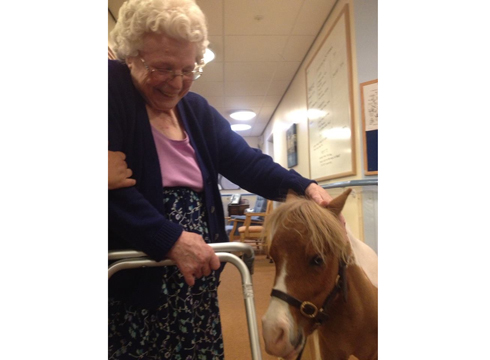
    Lean on me: Monet makes a new friend in a care home
    Lean on me: Monet makes a new friend in a care home

    Their owner Katy Smith believes that the ponies, which are roughly the same size as a golden retriever, are a great form of therapy.

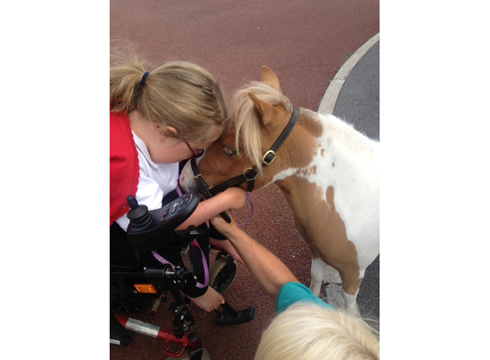
    Chatterbox: Mr P has a conversation with Max
    Chatterbox: Mr P has a conversation with Max

    “The horses evoke emotions and help people that are normally very withdrawn and find it difficult to communicate with people,” Katy told H&H.

    Pukka up: Annie is regularly visited by the ponies
    Kiss me quick: Annie is regularly visited by the ponies

    “I have had patients that won’t talk to people either having a silent conversation or talking away to these little horses.”

    No one misses out on visits from the ponies as they do bedroom visits and even take the lift see patients.

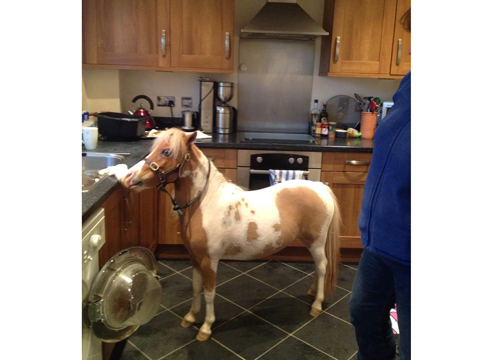
    House trained: Monet helps out in the kitchen
    House trained: Monet helps out in the kitchen

    In his spare time Mr.P is also a successful show pony and has qualified for the Horse of the Year Show (9-13 October)

    The ponies have also been nominated for the Animal Hero Awards.


    (Originally published on horseandhound.co.uk  


    Thursday, September 26, 2013

    Are Horses Innately Vicious?


    Are horses a "vicious species"??  What affect would this ruling have on the horse industry in Connecticut?  What about the horse industry everywhere in the US?  ~Declan


    Bite by farm horse kicks off lawsuit before Conn. court on whether horses are innately vicious


    HARTFORD, Conn. — After a horse named Scuppy bit a boy in the face, a Connecticut court came to a conclusion that threw animal lovers: Horses are a naturally vicious species.
    Horse owners and farmers are mobilizing as the state Supreme Court hears an appeal in the case Tuesday. Such a classification — the nation’s first, if it stands — would make owning horses uninsurable and jeopardize the state’s sizable horse industry, farmers and horse owners say.
    “You could not pair children and horses, the core equestrian business nationwide that it’s all about,” said Doug Dubitsky, a lawyer who represents farmers and horse businesses.
    When the boy tried to pet the horse at Glendale Farms in Milford in 2006, according to court papers, the animal stuck his neck out from behind a fence and bit the child on his right cheek, “removing a large chunk of it.”
    In February 2012, the mid-level Appellate Court overturned a lower court ruling and said that testimony by Timothy Astriab, whose family owns the farm, demonstrated that Scuppy belongs to “a species naturally inclined to do mischief or be vicious.”
    Although he had no knowledge of Scuppy biting anyone before, Astriab testified that Scuppy was no different than other horses that would bite if a finger was put in front of him. “Significantly, Astriab acknowledged his concern that if someone made contact with Scuppy, whether to pet or feed him, they could get bit,” the justices said.
    The injury suffered by the boy was foreseeable and the owners of the farm had a duty to use reasonable care to restrain the animal to prevent injury, the Appellate Court ruled.
    Astriab did not return a call on Monday seeking comment.
    If allowed to stand, Connecticut would be the first state to consider horses as inherently dangerous, said Dubitsky.
    Horse farmers and equine enthusiasts, who cite 2005 statistics saying that the horse industry contributes about $221 million a year to the state’s economy in boarding, training, lessons and breeding businesses, are asking the state Supreme Court to overturn the Appellate Court’s decision. The Connecticut Farm Bureau and Connecticut Horse Council filed a friend of the court brief saying that under common law viciousness generally is judged individually according to age, breed and gender, not as an entire species.
    Fred Mastele, acting president of the state’s horse council, said it is encouraging horse owners to attend the hearing Tuesday and support the Astriab family.
    “In our opinion, horses are not vicious animals,” he said. “They are certainly not attack animals.”
    Astriab had won at a lower court in 2010, when a New Haven judge sided with the horse’s owner and ruled that the child’s father, Anthony Vendrella Sr., failed to prove the owner knew of previous incidents of aggression by Scuppy.
    The Superior Court judge said Astriab testified that neither he nor anyone else had ever seen Scuppy bite a person before and that in 28 years, none of the horses at the farm bit or injured anyone.
    “Cats have a tendency to scratch and horses have a tendency to bite, but the plaintiffs have failed to show, as they must, that the defendants were on notice that Scuppy specifically, and not horses generally, had a tendency to bite people or other horses,” Judge Robin Wilson ruled.
    To leave comments directly on the story <CLICK HERE>